
Spirits were high at the Morean Center for Clay in the warehouse district of St. Petersburg, Florida during the opening of two of their best solo shows this year: De Aquí, De Allá by Alexia Benavent-Rivera, and “Happy Birthday Stinky!” by Jenny Day.
The chatter of the attendees caused the air of the old train station to hum like the bees in the spring. The space itself had a quaint but sublime aura. Ceramistic studios and over a dozen kilns dotted the grounds, and refreshments culled toward the back. However, the guests were parched for art.”
Quiet Lunch readers may remember our article a few weeks back on the Morean Arts Center’s Fresh Squeezed 10: Emerging Artists in Florida, https://www.quietlunch.com/fresh-squeezed-10/ if not check it out at this link! And, yes, this building is a part of that very same Morean tapestry.
An eager thrum led into the first pocket of white boxed gallery niches, Jenny Day’s show Happy Birthday Stinky! Which immediately transported from the mundane into a colorful birthday party for a skunk! Well rendered globs of clay sculptures piled into the middle of the room by the dozens. The artist’s fingerprints are evident all over–pinched and smoothed into the clay, glazes slicked on in a charming rainbow of hues. Dead leaves, a Happy Birthday banner, cigarette butts, a burst open dinosaur piñata, half-eaten plates of cake, and more filled the space. It all spelled out a delightful tale. But one that could have the potentially ominous implications when squinted at with care.
Nonetheless, we’ll let the artist speak more to that in the Q&A portion below!
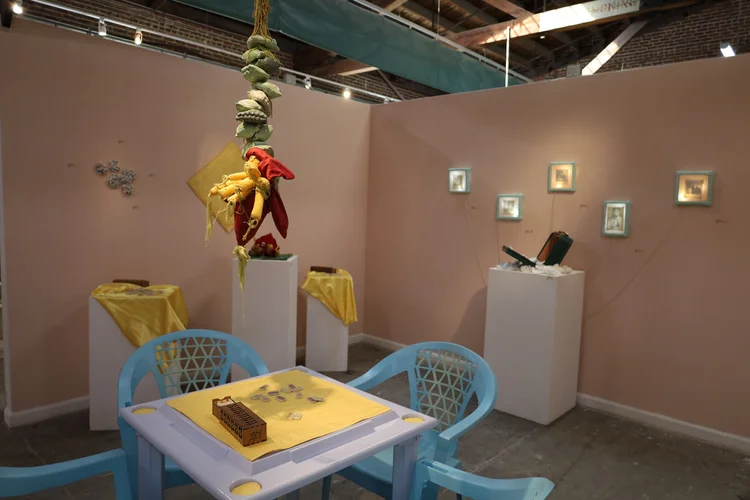
Next, the night led into the faintly pink walls of Alexia Benavent-Rivera’s inspired solo show De Aqui, De Allá: Connecting with Home. Coasting into the installation was very dreamlike, as if you’d walked into a living room you’d forgotten was your own. Utterly foreign yet familiar.
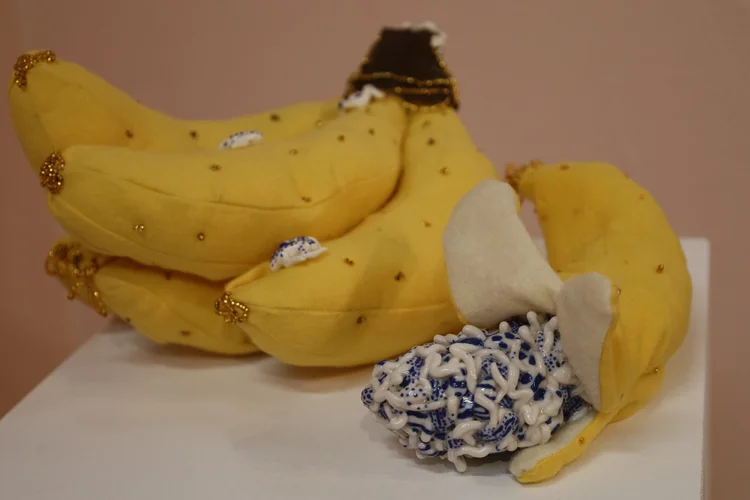
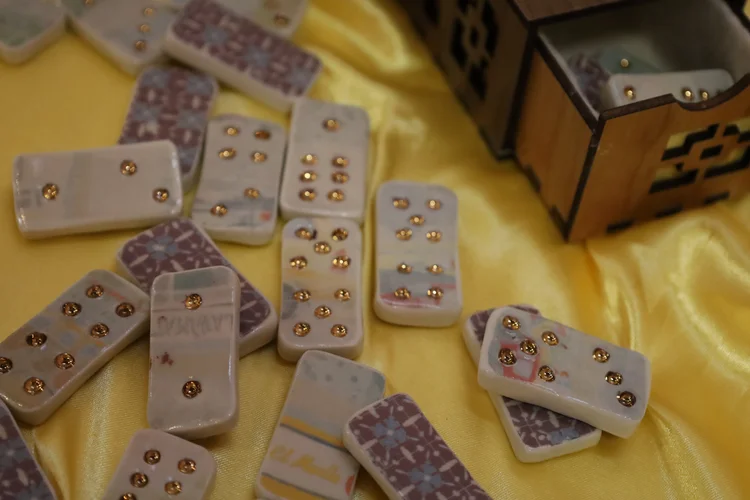
A banana bunch chandelier hung from the ceiling, over a table set with hand-crafted dominos left mid-game. Pictures and sculptural works hugged the walls, including a particularly unique piece that evoked the vintage white fridges of a youth left behind, spotted with colorful alphabet magnets.
Speaking to the artists directly further illuminated their already voice-y work.
Alexia Benavent-Rivera
Quiet Lunch: Walking into your show, De Aquí, De Allá: Connecting with Home, I was pleasantly caught off guard by the homage to alphabetic fridge magnets! The colorful sort so many people grew up with as little kids. It stirred a potent sense of nostalgia (and even personally inspired part of a new painting for me). It felt like the hyper-personal being transposed into the universal. The exhibit as a whole felt like coasting into a stranger’s dreamlike living room, somehow already worn into the familiar. How imminent is a sense of nostalgia in your work? What is it you hope to evoke in gallery-goers upon first entry?
Alexia Benavent-Rivera: Nostalgia is something that is always in my mind especially with work surrounding Puerto Rico. I hope viewers can find a relatability in this nostalgia and maybe feel a little bit of their own home and histories in it. On first entry I want viewers to feel like they’re coming home to something they had almost forgotten. Nostalgia is such a powerful part of that message that it feels necessary for me to convey that sense of belonging.
The touches of the hyper-personal came in part from the heavy Puerto Rican cultural resonance. Can you talk about your background, and your culture’s influence in your work? Feel free to offer as many details as you’d like.
I was born in Puerto Rico to a Panamanian mother and a half Puerto Rican, half Ukrainian father. I always felt like part of what made my experience in the diaspora real was the tangible memories I had from my time in Puerto Rico or that family I have from Panama. Most of that weight comes from Puerto Rico since I lived there for a part of my childhood. While my relationship to Panama is now something I strive to be closer with, it was somewhere only visited occasionally so I didn’t know how to connect with it for the longest time. I had the same issue with Ukraine as it was a completely inaccessible world away. Little by little I’ve learned how to connect more with all parts of my heritage, and it has become something I value very deeply. In my work I try to bring the patterns, symbols and sounds of my homelands to wider viewership. Through this ongoing connection I’ve realized that things my family did were and are so attached to cultural identity. Little things like the food we eat, the music that fills our home, or the way our voices all blend together as we talk over each other at dinner. Oftentimes we are so used to parts of our culture embedded in our daily lives, we forget to acknowledge and appreciate it.
QL: What do the words “home,” “nostalgia,” and “diaspora” mean for you?
ABR: In some ways they all feel one in the same at this point for me. Home now has transformed into something that is simultaneously the now, where I live and where my friends and family are, while also being the past of a place that once was comforting to me. It is also somewhere I long to be and often travel back to both physically and mentally. Maybe that is too philosophical but it feels like so many things at once. Nostalgia wraps up into home so nicely because the comfort that comes from home becomes embedded in the nostalgia.
Diaspora is kind of a loaded question for me, it means so much in ways big and small. It is the contradiction of being a part of something by being apart from it. Diaspora is always tethered to home but it is forced to stay distanced from it, many times unable to return.
QL: I’d love to hear more about your studio practice. Can you take us through a typical day in your studio? Why you choose the mediums and materials you do. How your hands and mind converge on a project. The time each piece takes. Perhaps what informs your aesthetic decisions, etc.
ABR: I incorporate so many mediums that a day in the studio can go in a dozen different ways. One constant is that I like to spend time at home away from my studio brainstorming ideas. I’ve noticed my best ideas crop up while I am working on other projects, and while I love my brain’s enthusiasm, I think it’s helpful for me to break out those ideas when I’m not being distracted with other projects. I might mull over ideas for a long time before they make it to physicality in the studio. Sometimes they spend weeks in sketchbooks and phone notes before I flesh them out.
There’s a whole phase also where I sketch and plan quite a bit. I’ll keep multiple ideas cooking at a time, so if I feel like I’m hitting a block with one piece, I can pause it and work on another stage of a different work. It all sounds so chaotic when I describe it but in my brain it works like a tree with many branches still part of the same trunk.
My studio time is spent on intuitive missions each day. I try to separate work out as “ceramics days” or “printing days” so that I can give full attention to whatever part of a project I’m working on. A set plan (even if it doesn’t go right) is the only way I can use my time effectively, especially because I move between so many mediums.
I make my aesthetic decisions both intentionally and intuitively. I think first, especially in regards to my soft and hard work, I think about our expectations around the imagery and how it could work towards my content. From there it’s almost like working backwards, if I did this as ceramic and that as textile, how would that combine? What color would it be? What texture does it need? And selfishly, is it satisfying to hold and look at?
I like to listen to a lot of media while I work, and while sometimes it’s silly podcasts and fun fantasy books, most days I find it more helpful to listen to audiobooks about my research. It keeps me grounded as I work and lets me truly focus in and be deliberate with each step. I work in a flow state that is almost meditative. It feels so nice to have my hands working, and I think that’s why I love so many process based mediums. I can have my hands in everything and every single element is intentionally made or touched by me with care.
QL: I noticed your show was very mixed media. Do you find that hard to juggle? And what mediums and genres of art making do you consider yourself to be a part of? i.e. ceramist, sculptor, installation artist, and so on.
ABR: It’s funny I don’t find juggling the mediums as difficult as finding what category my art falls into. I graduated with a BA in Interdisciplinary Studies in Art and Design and then my MFA program encourages media fluid work as well so I feel as though the more I grow as an artist the less I identify with any one title. I used to consider myself an illustrator, then a printmaker, then a ceramicist, but as I took on each new medium I wanted to hold on to those identities even more. I’ve landed on calling myself a media fluid artist, with an emphasis in ceramics, textiles and printmaking. I’m sure as time goes on I’ll wear more hats and pick up new ways of describing myself in relation to the art world. I’m not sure we’ve had this much cross media work in the mainstream art world so I’m sure new titles are imminent.
QL: The pale pink walls were a nice touch! (So happy to have gotten to white box the gallery for your install!) How important are those extra details to your initial vision?
ABR: Thank you! I wanted the space to feel like home and for me personally I have never lived in a white box! As soon as I move into any space a wild color choice and paint job is close behind. I picked the color based on my grandparents’ home in Puerto Rico. It felt personal and also it wasn’t so bold to distract from the work while still pushing out of the sometimes sterile gallery feel. It was important to me to make it feel like a portal to somewhere you feel like you already know, a space that moves in its own time. I am trying to hold that space because, especially in today’s political climate, it’s important that we hold as much space as we can.
Jenny Day
QL: “Happy Birthday Stinky!” utilizes the gallery space in a very unique way, wherein the perimeters are entirely clear, and approximately a hundred ceramic sculptures are clustered in tiers toward the center of the room. Was the presentation of the work collaborative, or a firm vision you had from the start?
Jenny Day: Actually I had a very different idea when I first was making the work for this show. I thought the installation would start from a back wall that would evolve into leaves, candy, cigarettes then, sculptures. Once I saw the space in person I realized that with the work I had it would be more interactive if it was something you could walk around and get close to. The tiers were a collaborative idea.
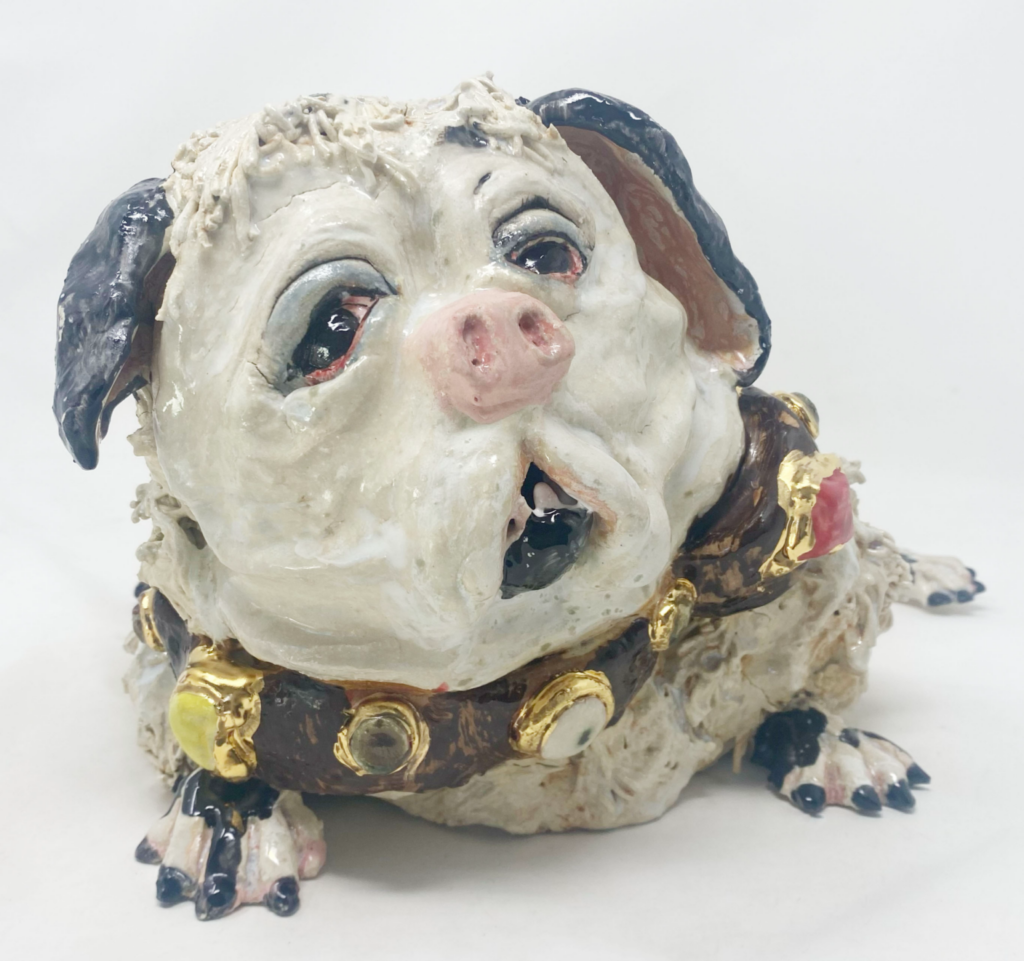
QL: The titular Stinky is a skunk celebrating his birthday amidst hushed clues of an apocalyptic backdrop. Stubbed out cigarettes and leaves scattered between gobs of cake and deflated balloons, loose candy litters the ground from a burst open dinosaur piñata, hiding a dead bluejay. Does your body of work at large tend to center characters and storytelling? Like a skunk partying at the end of the world.
JD: My work has often been compared to natural history dioramas of the apocalypse. I appreciate that the natural world continues with or without us. I think we forget that we are not separate from it. With my work I hope to express deep concerns for the natural world and our place in it with humor and whimsy.
QL: My first impression of the work was that it could inform two opposing interpretations. One being that these colorful forest animals celebrate in high-color to push back the realization that the end of the world surrounds them. Perhaps a warning to hyper consumers with our heads down, concerned with selfish thrills while our environment is in ruin around us. The other interpretation being that these animals aren’t ignorant to the end of the world, but instead seeking whimsy in spite of it. Or perhaps because of it. What were your conceptual intentions while creating this work?
JD: I appreciate all of those ideas! I tend to lean towards the idea that nature, and us, are adaptive beings and will seek out survival. That we will find a way to endure. I wanted to create something that was multiple things at once, beautiful, silly, disgusting, oozing, playful, worrisome. That for the careful observer there would be hidden details and layered meanings. That the viewer stumbled upon an event that makes them ask questions and be curious.
QL: I’m curious if you have any tidbits of feedback you’ve gotten from gallery-goers? Takeaways from laymen who walked into the show blind, all the way to other artists and loved ones. With this exhibition, most people were surprised by the details, candy, cigarettes, the dead bird, and finding the skunk. Also a few commented on the volume of work.
JD: With this exhibition, most people were surprised by the details, candy, cigarettes, the dead bird, and finding the skunk. Also a few commented on the volume of work
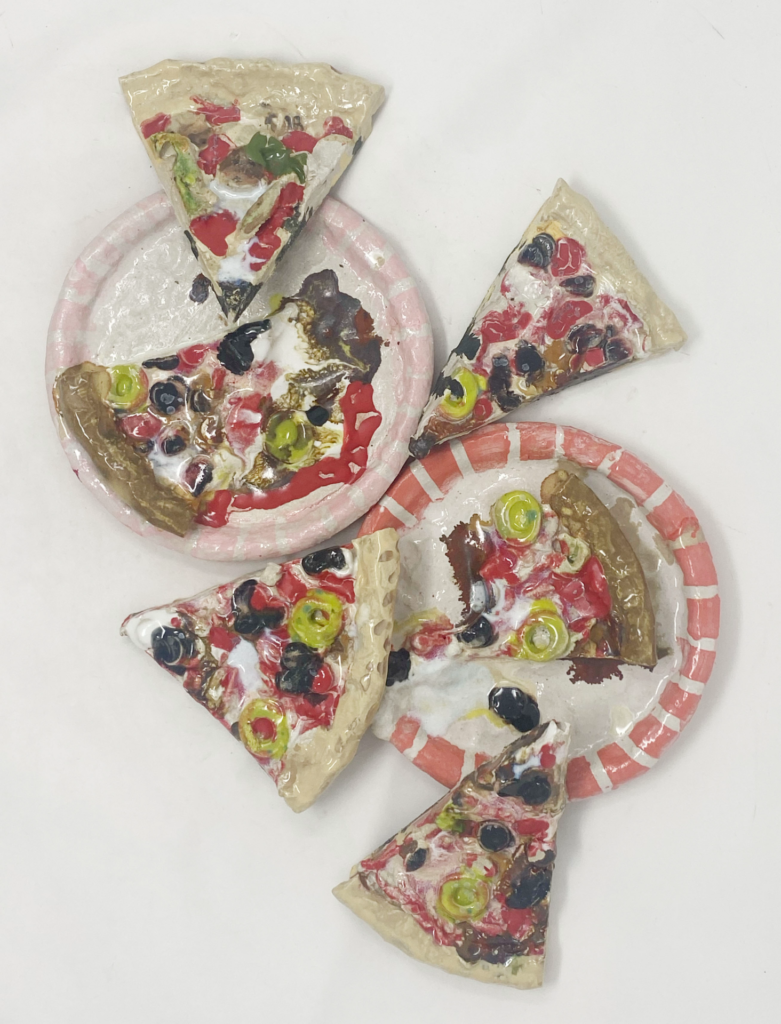
QL: There are so many individual artworks displayed in “Happy Birthday Stinky!” That must have been extremely labor intensive. Can you walk us through the time this took you, the highs and lows of sculpting, firing, glazing, and even transporting the work?
JD: This body of work took about nine months to create. I made it in my studio in Santa Fe. I fire pieces multiple times from Cone 6- Cone 020 in electric kilns. I end up using a lot of soft brick and sand to make sure the work does not stick to the shelves. Some of the work was knitted in wool and slip cast, then burned out in the kiln. Other pieces were made with wire. Most of the pieces though were made with hand building techniques. Creating big installations like this is a huge process, usually involving sketches and mock ups. I also make sketches of the individual pieces to test out glazes and make a lot of notes about glaze combinations. I come to sculpture from a painting background, so I think of glazing more like layering color and creating surface.
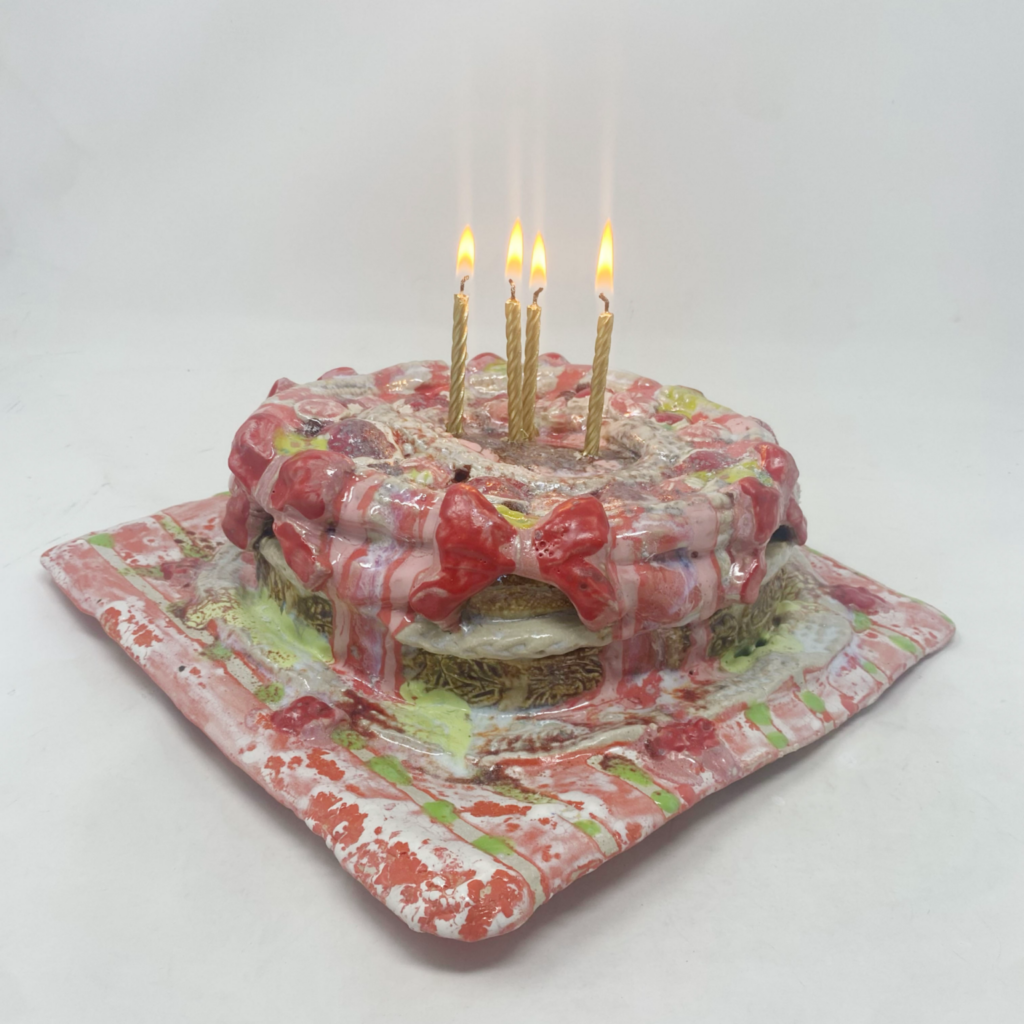
Check out these artists online to see more of their work and creative journeys!
Jenny Day Instagram:@jenny.marie.day
Website: www.Jennyday.com
Alexia Benavent-Rivera @alexiakat.art
Website: www.alikat.org
And check out www.MoreanArtsCenter.org for the latest upcoming showcases at the Center for Clay!

Quiet Lunch is a grassroot online publication that seeks to promote various aspects of life and culture with a loving, but brute, educational tinge. When we say, “Creative Sustenance Daily,” we mean it.
Comments
Wow such detail and mixes of material. Love it so much!