
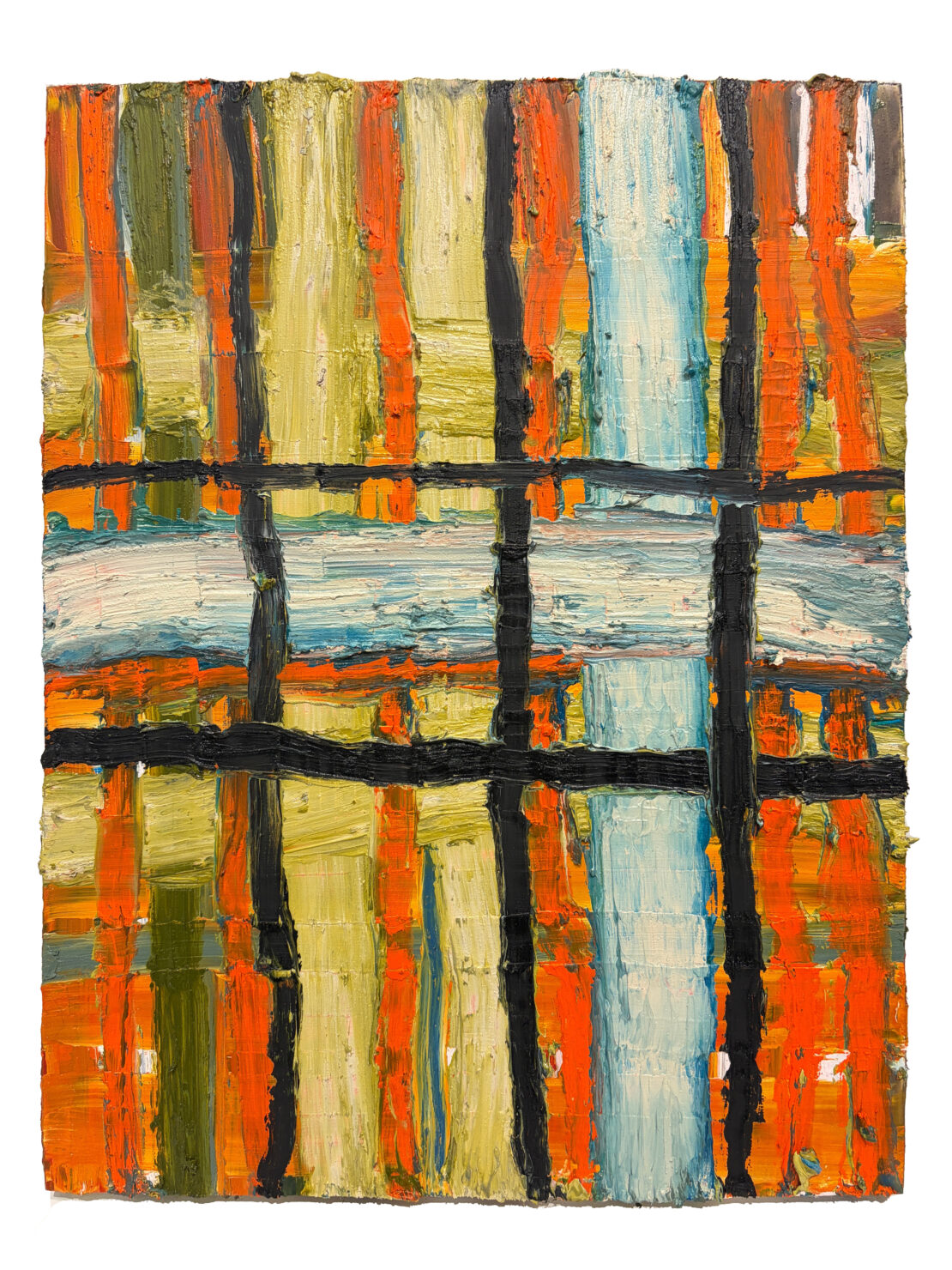
New York’s conceptual art scene has a rising starlet with work worth lingering exploration: Olivia Gossett Cooper. Her practice delves into the mediums of abstract expressionist paintings, and found-object installations, that feel both instinctual and pointed.
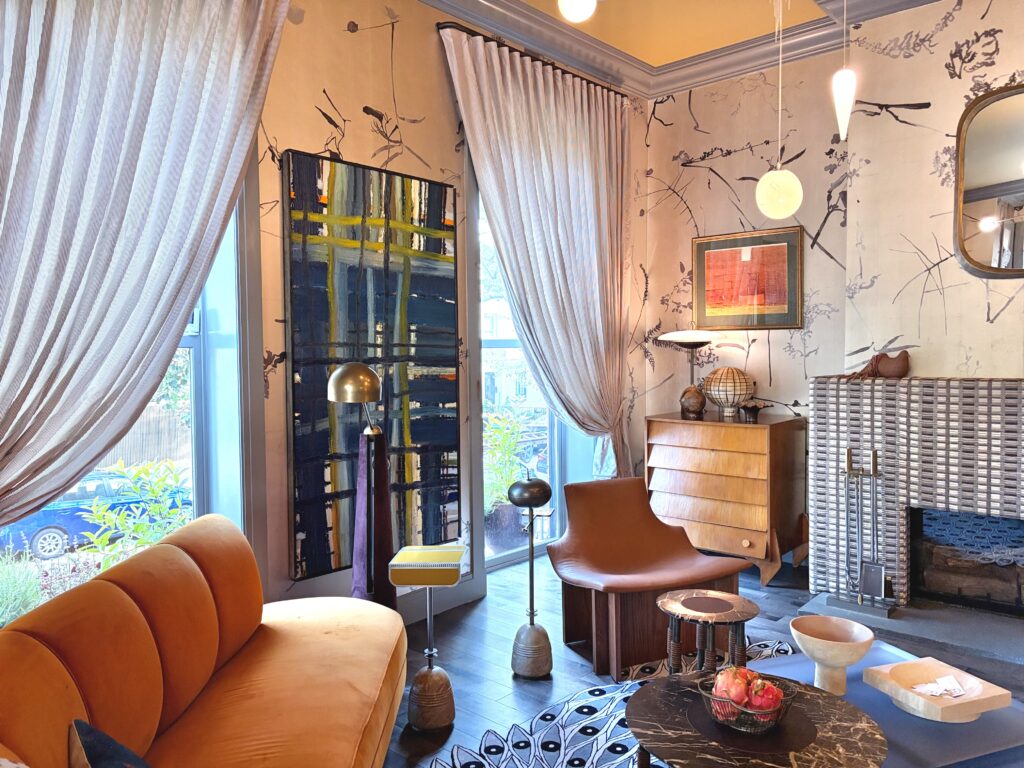
Quiet Lunch caught up with her after one of her latest exhibitions, Five Below. A group show put on by Marinaro Gallery in collaboration with Loft Projects–an incubator for emerging artists. The artist’s latest boons include an invite-only biennial for interior designers to participate in designing a room within a volunteered home in Brooklyn. The proceeds from tickets to visit the redesigned home go towards The Brooklyn Heights Association. Wherein one of Olivia’s paintings is highlighted in the townhouse’s parlor, which will be open to the public until November 1st.
https://www.brooklyndesignershowhouse.com
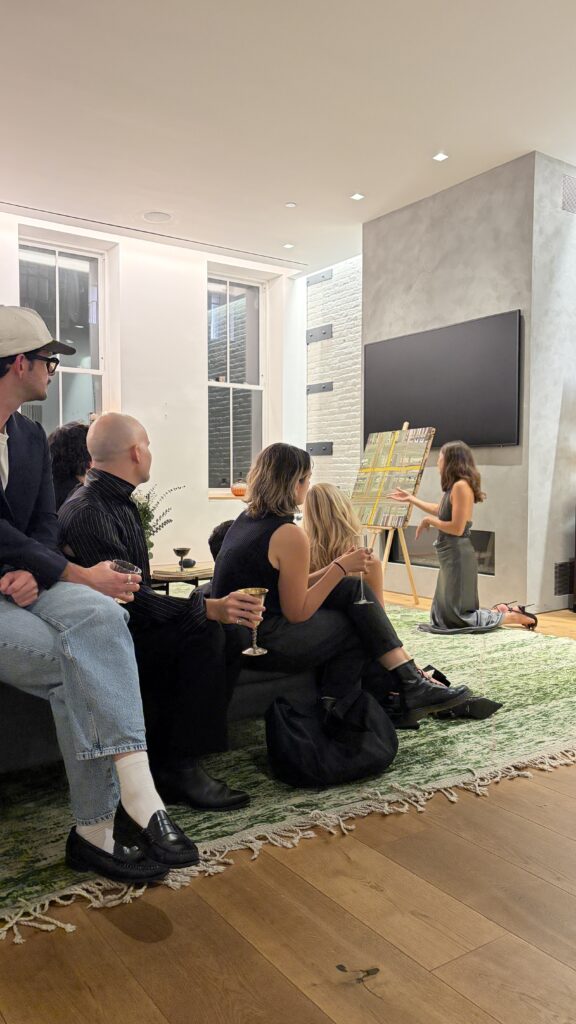
Olivia also recently participated with The Salon, which hosts art salons of different variations in cities around the world — Paris, New York, London, and soon San Francisco. They partner with hosts who open up their homes or space to hang artwork from select artists, and then facilitate an evening of mingling that’s nurtured into group reflection around the featured works. The artwork is for sale that evening, and opens to the public for purchase and viewing by appointment for one to two weeks following the initial evening event.
In this salon experience the artist showcased four paintings in Tribeca. Other participating artists include Noah Trapolino, Mays Jones, Kate Kerry, and Sarah Dixon. The formal event was September 26, but more information can be gathered by emailing info@itsthesalon.com.
Chatting with Olivia during this churring point in her career was especially insightful.
Quiet Lunch: Do you wanna launch right in? Okay, so I have some general topics of interest, but they’re really just a guide because I’d love to hear whatever it is you have to share. If you want to go off on a whole nother tangent. We’re totally here for it. My first topic of interest is periods of art history. If any in particular, speak to you, if any are kind of repellent to you, or are in dialogue with your work. Especially within the postmodern era.
Olivia Gossett Cooper: So there’s two that really come to mind. And the very first artistic movement or period that I remember hitting me like a brick wall of inspiration and just feeling was Italian futurism.
I mean, I love visually what it was doing. With the movement and the colors, and one of the things I love about artwork and artists is the momentary–while you’re with the work–opportunity to see the worlds in a way that you hadn’t considered before.I think that’s a huge, and then later, you know, once you leave, it lingers with you and it impacts you in ways you might not even realize.And with futurism, I mean, it was such a blatant way of doing that, of considering the moments of movement and what that might look like if you could see it in slow motion with color and the energy of it.
So visually it was very compelling for me. And then I learned more about it, and it was this kind of rebellion against the more traditional. Like a Renaissance. Traditional work, doing things as they’d already been done for many years. They wanted it, the people of that movement. The manifesto was about going against that, and innovation, and ‘let’s move forward in art.’
Quiet Lunch: Wow, that really stood out to me though. When you said something lingers and like it stays with you, the work stays with you…perhaps even if you don’t know what it means yet. And that really speaks to me about all of your works I’ve seen. Because it’s like: ‘I get it, but do I get it? Wait, what am I getting? What am I not getting?’ There’s this tickle of the brain where it’s not pandering and it’s not shortcutting the meaning for the audience.
Olivia Gossett Cooper: Oh, thank you for sharing that. It’s always fun to hear how the experience for the viewer is. I don’t like being too on the nose with my work. I think it’s more compelling for the viewer to be able to fill in the gaps with their own stories. And then you can also keep thinking about it. What is it actually about? I don’t think [my work] is about any one thing ever. What I try to make is work that speaks to me. I think it’s relative, independent of your own life.
QL: And it can change too, I imagine. Perhaps when you’re in a different place in your own psyche.
OGC: Yes, that’s great. Because, I totally agree and that’s the hope for my work–also it’s more enjoyable to make that way.
QL: How so?
OGC: When I know what the destination is, and exactly how the journey’s going to be to get there, it’s not really as fun to make. I mean, in life, I love going on spontaneous adventures and not knowing exactly how they’re going to end, and that very much shows up in my art practice.
QL: And so kind of speaking to that–the moralism or the fairness aspects, et cetera… I’m sure you’re familiar with the idea of the moralist, versus the voyeur, or the sadist?
OGC: No, I’m not familiar.
QL: Well, there was this artist, Marco Evaristti; he had an installation at the Trapholt Art Museum in Denmark, and he put live goldfish in a blender. Then he invited the museum-goers to press the button, and murder the fish. His philosophical theory was that those who say it’s awful and perhaps try to stop it or speak up are moralists. Those who just want to see what happens on the edges are voyeurs, with this strange curiosity. And those who press the button are sadists.
OGC: You know, now that you mention it, I did. I have heard about this installation.
QL: Yes, and I think it speaks to broader topics beyond the shock value. What would you do?
OGC: Oh my god. I’m definitely a moralist through and through.
QL: And PETA was indeed called.
OGC: I would be so nervous to go up and just take it. You know? I don’t know what I would do. That would be a hard one. If I knew we could? I think I would do it, but there’s this–you know what it is?–I would have hope in humanity. I’d be like, no, there’s no way they would actually let someone. I would seem crazy going and [turing the blender on] because there’s no way they would actually let people do that.
QL: Well, what’s so interesting about what you’re saying is it kind of hints that this idea of the voyeur being present, like the space is activated by who is in it and what they would think of the action rather than in a vacuum. ‘Would I do this or not?’ Who’s watching is what activates the action itself, so to speak.
OGC: That is interesting. Well, where we met, I had a blender piece and two people tried to turn it on.
QL: They really tried to turn it on? That’s interesting.
OGC: So, it was an old glass blender filled with river rocks and it appeared to be plugged in.
QL: Was it plugged in? I forget.
OGC: I got a plug, but it wasn’t actually connected to any electricity. So it appeared to be plugged in and two people tried to turn it on.
QL: To just blend rocks? Great idea guys. Driving interaction though.
OGC: You see, but dude, I guess I feel that all of my artwork is alive.And, in a way, can be interacted with by the viewer. Like it almost completed the piece that somebody tried to turn it on. Because there’s this kind of edge-of-your-seat suspense when you see river rocks and a glass blender. It’s like, you just want to do it. It’s on the edge of chaos and it’s just like one button away. It tickles your brain. There’s something tickly there, which I find in all your work. Even your latest paintings, like I mentioned a bit our email thread. I was like: I don’t know what to think yet. I’ve got to sit with these. So it’s easier to be in a conversation because I suppose I’m still trying to listen to the piece discover, wait, what do I feel about these paintings?
QL: And it’s interesting that you mentioned Italian futurism, because I am starting to draw on some threads of my own for my little knowledge of it. Like, we’ve spoken about in the recent past you’ve had more found-object, installation-based artworks. And now this shift into these paintings for Five Below that you mentioned weren’t centering stories of the home and motherhood. So, I’m curious what spurred in that shift.OGC: After, I spent a year basically making work about home dynamics, because I really felt I had to– It was something cathartic. And I also, I found the more personal I got about it, the more actually universal and connecting it was to others.
QL: Specific to universal, yes.
OGC: So, because it was truthful. I like to paint the truth, and I think that that can connect with people. And that was really nice.
QL: Yeah, this new work was perhaps not as narrative-based as you’ve broached on before?
OGC: Yeah, there was definitely a narrative [within those earlier works] but, you know, not completing the story though, letting it be. Letting the viewer fill in exactly what it was about, based on what was going on in their life at home.
So maybe more like prompts for the viewer to think about, or think of a story that it reminded them of at home or in [their own] dynamics.
I started doing these layered scratch paintings related to the sculptures that were also about home dynamics. I had a studio visit with somebody, an NYU art professor actually, and there was one painting in particular about the subconscious that comes out while you’re just mindlessly folding clothes. And it had a lot of texture in it, and he was like, I love this texture, like, have you ever considered working with marble dust?
Just to create and add more texture. I’d never really considered texture before. It showed up sometimes by chance in my paintings. But I went to the store the next day. I bought a bit of marble dust, and I laid it down on a new painting I was working on. And similar to in the Wizard of Oz, how Dorothy walks outside the door after the tornado and sees color for the first time. When I worked with the marble dust, it was this weird experience where I felt like I was seeing texture for the first time.
It blew me away. I became…I fell in love, and I was just so amazed at the material itself, and that it could say something in and of itself.
All I did was put a smear down to test it out and it had a presence because of the material. I was overwhelmed with [the marble dust] and I needed to do more, and it was also this wonderful shift away from talking about something and imposing my life experience, and what I wanted to say. I shifted away from that to this like, “I don’t have to talk about this.” I can just make a painting. About the paint. About the thing.
And about the texture, and about what happens when this color mixes with that color. Literally, a painting about the material itself because it has so much to say and can reveal so much depending on who’s looking at it and how they’re looking at it.
QL: Interesting.
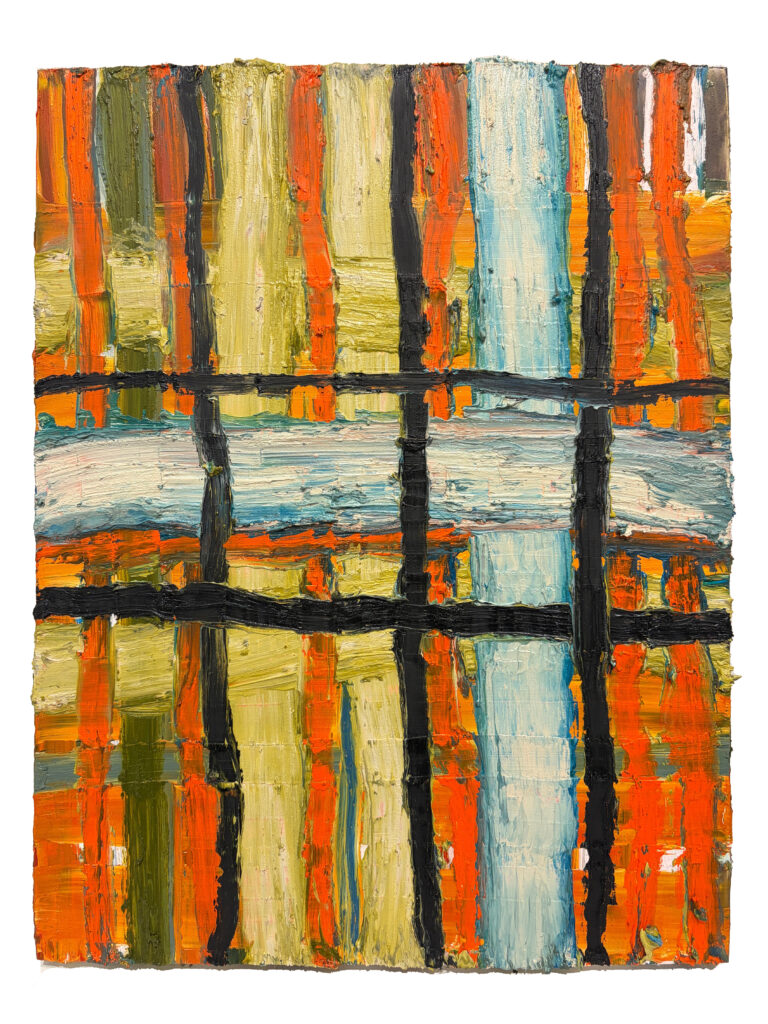
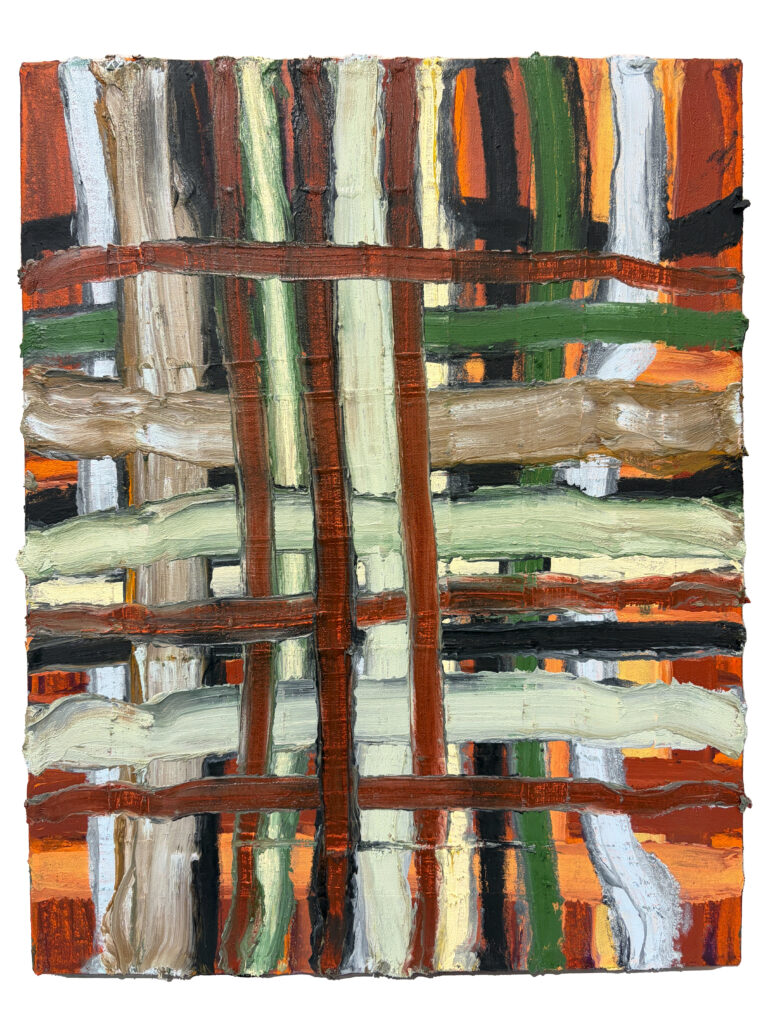
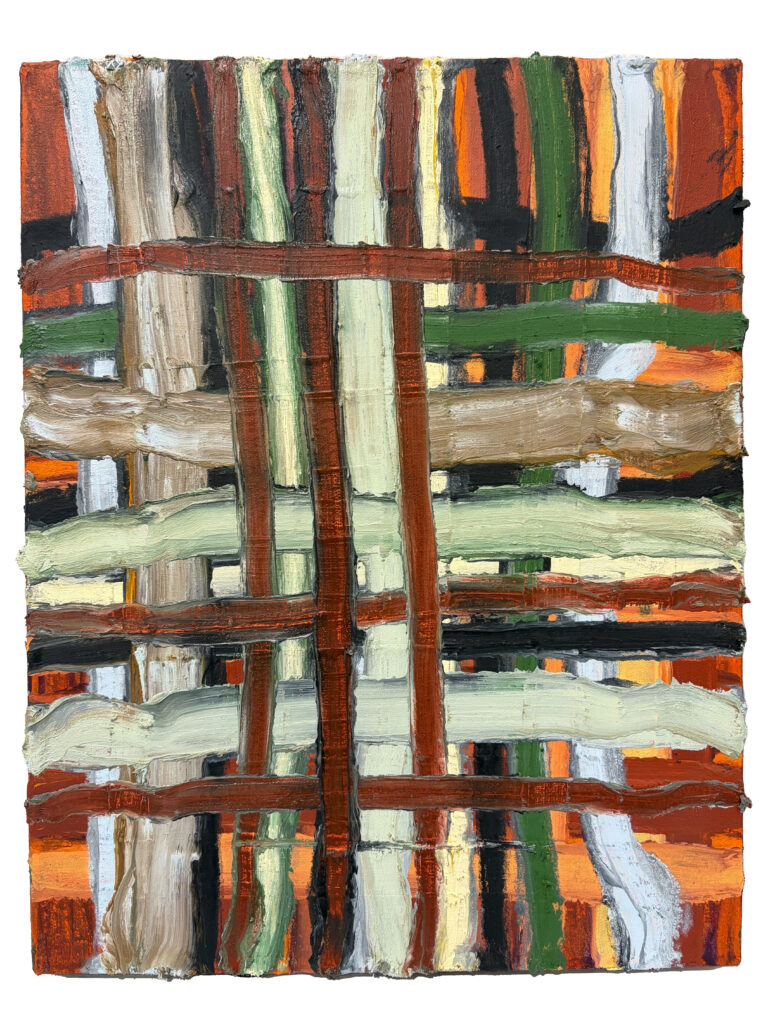
OGC: It was a great day [in the studio]. I didn’t know what else to do–I just wanted the strokes of the paint. At [an earlier point], I wasn’t using marble dust. I was just using paint, but laying it on thick so it could have this physical presence. So I just did one stroke across the canvas over a painting I was working on, then I did another because they felt like they wanted to interact, and that’s kind of how these line or grid paintings started.
It was so wonderful to be a female artist, to be a mother artist, and not feel compelled to talk about it, anything about it.
QL:Ah, right. So it’s kind of like the whole conversation on decentering men. It’s like centering self. Like, it’s just the presence of the materials and you as an artist rather than your relationship to other things, is that kind of…
OGC: Yes, totally. I think as female and mother artists, it’s like stamped on our forehead that that’s what we are.
QL: An inextricable bond.
OGC: Yeah, and I am here, existing here outside of that as well, and I don’t have to talk about it, and I can just—
QL: There’s so many aspects to you and the work, so, yeah, I hear that.
OGC: Totally. And these lines are expressive and I’m still figuring out exactly what they mean. At the finish of a painting, in some abstracted way, I’m sure that these “things of my life” show up in the work. But it’s not intentional. I’m not pushing a narrative or a prompt or a story into the work. I’m letting the material speak for itself.
QL: Well, it’s interesting the way you’re speaking about the studio practice, because it’s similar to what we were saying earlier; you’re creating these spaces and objects, but you’re not filling in the blank for the viewer. But it sounds like with these paintings, the blank isn’t even filled in for you yet. And so it’s like a conversation with self that is then placed into the third space of the gallery for all these other people to add to the conversation. I imagine for you this may form a brand new edge to the work. A ‘who knows what they’ll think’ kind of energy?
OGC: Totally. I think that’s a big part of it. I wanted that almost mind-break, or palate cleanser away from narrative and narrative work for the viewers. I mean, another part of this is there’s a lot to talk about going on in the world right now.
QL: Oh, gosh. Oh, my God, yeah.
OGC: There’s so much work being made to talk about it. And that’s so important. And I’m grateful that those works are there to help process what’s going on. But at the same time, there can be a bit of fatigue. If that’s all the artwork there is.
QL: Fatigue, yes. I just felt it when you said it, I went: “Oh, I do feel that way.”
OGC: I believe it’s nice to have to take a breath. Having a painting almost sit in between all of that noise.
I think that’s also needed right now and I, gosh, I forget who it was. But there was an artist talk I went to, and she makes really bright, colorful paintings. And then one person asks: ‘You know, how do you deal with making these bright, colorful, happy paintings with what we’re going through right now; where things aren’t always so bright and colorful and happy?’
And she said: ‘I feel that artists have an obligation to both make work that talks about what’s going on, but also give you a break from it as well.’ And that really connected with me. That’s what these [paintings] feel like more of.
QL: And there’s always the concept of joy as resistance.
I covered a show recently down in Florida, where the artist created an apocalyptic birthday party for a skunk. So it was very colorful and joyous. But there were these elements that made a viewer question what’s going on in the vignette. Perhaps the work held a dark narrative.
OGC: And what did the artist say?
QL: Her response was to the effect of: Are we partying because it’s the end of the world? Are we partying against the end of the world? Are we optimistic and being oblivious, or does the work encapsulate the idea of joy as resistance?
OGC: I really love that. That’s great. It’s so true. I mean, there’s also a declaration of existence, and the power of existence, just within each line. For the paint, the line, and for the energy within the line itself, saying: Here I am! And also for me as the painter laying it down and also the viewer for like taking it in. It’s like, there’s a nice, I’m still trying to like understand that myself a bit, but I really am grateful for that part of it.
I am almost five years sober and in sobriety there’s this like, sense of higher power.
And however you want to, you know, define that for yourself or connect to that, but it’s a big part of my life and my practice, like letting go of my own will and just, like, letting a higher power’s will into the space. And letting that almost guide what I’m compelled to make each day. And so this feels like it’s coming from that and is like solely being revealed to me as well.
See, it’s so interesting when you started in the middle there to talk about the line making itself and how it has like this presence and declaration of existence and it was like, you know, abstract language, but it was clarifying to me about the work. It came into focus of, okay, I see more. Yeah, so that’s interesting to me. And you were also saying before about, like, this kind of centering of materials as opposed to relationship to others via home or motherhood. And I was wondering if you remember the whole debacle during the Hillary Clinton, I almost said Hillary Duff, the Hillary Clinton and Obama, Presidential Run, where Obama’s Instagram was President of the United States, some other thing, other thing, like huge accolades, father, last husband. Whereas Hillary Clinton’s was literally wife and mother first, before she got to her being, like, the secretary of state. And that just took absolutely everything to me in, like, a matter of, like, 20 words.
I don’t remember that, but, yeah, I mean, that doesn’t surprise me at all. I feel like she, she probably, I feel like if she didn’t do that, people would have called her out on it.
I feel like from, I’m not even a mother, but I have strong feelings about it. I’m realizing that talking to you, like, to the point where I very much want to adopt, and I tell myself, like, I think I’m gonna insist on being referred to myself as a parent, and avoid the word mother, just because of how, like, ridiculous all our society standards for motherhood is.
QL: Yeah, it’s just, like, very unfair.
OGC: Yeah, it’s definitely, there’s a lot of assumptions, yeah, standards that I don’t, that also, I think, we can put on ourselves as women.
QL: Fair, yeah.
OGC: Like we feel obligated to be a good mom and what that means in society today. Because there’s a lot of guilt felt when you feel like you’re not being a good mom.
QL: Mom guilt, yeah.
OGC: I mean, yeah, when you, as you’re talking about it, I have a, I’m, I’m up. I’m away from my studio, I’m up here in the Adirondacks up in New York right now. And but I’m like doing just small paintings up here, and I’m like looking. My husband and I come here every summer, like my husband and I got married up here. This is a part of, a part of me. And like as you’re talking about all this like mother stuff, I’m looking at one that I’m in the middle of making a painting. And I just like, I feel this power in its ability, in its like, not talking about it.
QL: What do you mean?
OGC: Where it’s like, it almost, there’s like this magnetic pull to like, reference womanhood or motherhood or like, even if it’s subtle. As a female artist with kids, and I’m just like, it’s, it’s, like looking at this piece in front of me. It feels like it’s got this like resistance against this magnetic pull, like, I will not talk about that.
QL: That’s so Scorpio.
OGC: Yeah, I was just like, I will not, I will say, and like lay down, what, what feels, what’s being directed by my art practice and the materials inside of that, like, period.
QL: Yeah. So very, like, very raw, very connected to, like, this, like, ancient center almost, it sounds like. But so it kind of sounds like you’re describing like a flow state, but that is also based in like this huge tension of pulling away from that magnetic force of, like, these experiences of motherhood, womanhood on all of those topics, instead of going to something even more primal, which is hard to imagine, but, like, yeah, as opposed to it.
OGC: Absolutely. I didn’t realize that even until you said it, but I have to actively not think about these identities that I hold every day. And for, you know, for every hour of every day, except while I’m painting these paintings in my studio.
QL: That’s beautiful.
OGC: It’s an act. So there is that tension. It’s like a mental tension of letting that go.
QL: A reclamation too, I imagine.
OGC: Absolutely.
Yeah, no, these, the last thing I’ll say about them is like, that to connect them to the object sculpture work I was making is like, you know, they are defiance away from it. Of course, like, not having to talk about what the sculptures were talking about. But, I feel like each object. I like, I feel like I tried to give life and energy to each object, in my, in the sculpture work, by letting it say something.
QL: Nothing was background.
OGC: Yeah. Instead of being there to say something rather than there as a function, which is what they’re usually for, these objects. So I gave it a voice.
And intentionality too, yeah.
Yeah, and I feel like that’s what I’m doing with the lines in my paintings, like, they layer together to create one whole work. But the lines are individual acts and like beings of energy, each with something to say.
QL: Okay, yeah. There’s a level of harmony there in, like, the palette and the texture, but there’s also, I’m seeing, I’m seeing that tension, the individuality of each line, because it’s like as if a plaid were made from, like, I don’t know, like cave people in a really good way, you know, like that grit. Yeah, you know what I mean, right? That’s like on the fly way to describe it, but yeah, like a primordial sensation.
OGC: So that’s, that’s a connector, because I know you, you connected, like, first with the sculptures, so trying to tie it back for you a little bit.
QL: I see that. Yeah, thank you for thinking thoroughly. I could totally see that.
OGC: I’m honored that this was helpful and you wanted to talk about it at all and, it was great to chat with you after, you know, what is it, like, two years that we first met, so.
QL: Oh my gosh, yeah! It was exciting to talk to you too, even though you’re Scorpio, I’m glad you have Libra placements, and I can see why your husband is enamored with you as he, of course, should be.

Quiet Lunch is a grassroot online publication that seeks to promote various aspects of life and culture with a loving, but brute, educational tinge. When we say, “Creative Sustenance Daily,” we mean it.